

Independent AI Engineering / Case study
AI Release Notes Generator
An AI-powered developer tool that transforms public GitHub commit comparisons into categorized, source-linked release notes, with structured validation and Markdown export.
Live generation verified
Public demo and quota-limited live generation. One real generation is verified; comprehensive model accuracy is not established.
Engineering result
Working public frontend on Vercel and an independently deployed Cloudflare Worker, using real GitHub comparisons and native Workers AI.
In this project
Overview
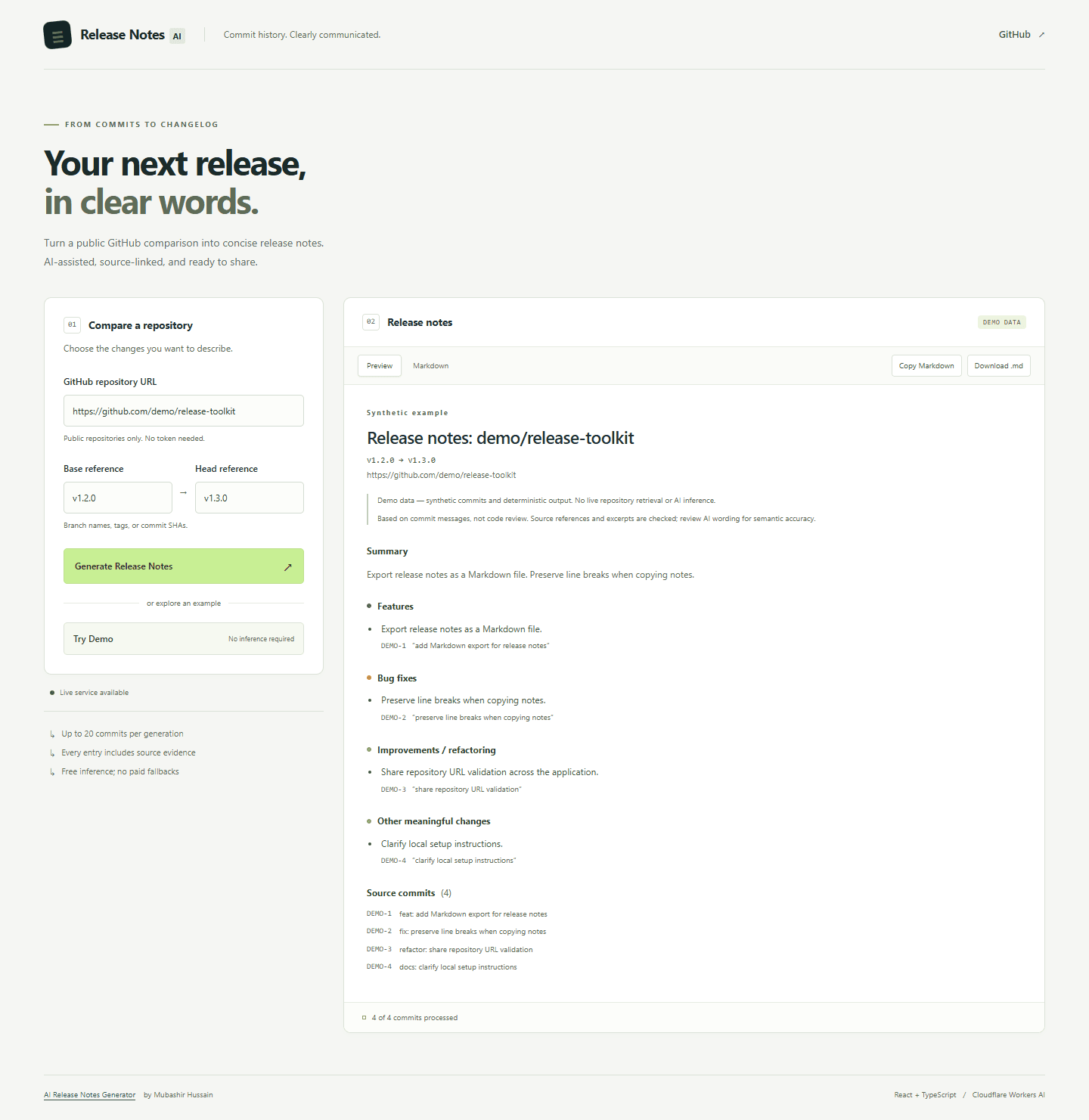
Built independently for developers preparing releases from public GitHub repositories. Compare branches, tags, or commits, review categorized notes against their source evidence, then copy or download Markdown. The frontend and Worker deploy separately on Vercel and Cloudflare.
My contribution
I designed and built the React/TypeScript frontend, GitHub integration, Cloudflare Worker, native model adapter, source-validation pipeline, deterministic formatting, tests, and deployment configuration.
The problem
Turning raw commit history into useful release notes takes developer effort. LLM summaries can introduce unsupported claims or fabricated source references, so a useful draft needs evidence checks and a clear human-review boundary.
Architecture
The browser loads the React/Vite frontend from Vercel. It sends a comparison request directly to the independently deployed Cloudflare Worker, which validates the request, applies edge limits, retrieves public GitHub commit messages, and calls Workers AI (Gemma). Schema and source checks precede deterministic summary and Markdown formatting; the browser displays the notes and handles export.
- 01Browser → React/Vite on Vercel
- 02Cloudflare Worker · validation and limits
- 03GitHub Compare API · commit messages
- 04Workers AI · Gemma
- 05Structured validation · SHA and excerpt checks
- 06Release notes · Markdown export
Production request flow. Try Demo uses a bundled synthetic fixture without GitHub requests or inference.
Technical decisions
- Use the native Workers AI binding with Gemma instead of a paid LLM API. The deployed integration needs no commercial model API key and has no paid fallback.
- Validate model output with Zod, then require retrieved full SHAs and exact excerpts from the bounded commit context. Reject invalid output rather than presenting fabricated success.
- Construct requests only to the fixed GitHub Compare API destination. Strict repository/reference validation, encoded coordinates, and redirect rejection constrain outbound retrieval.
- Build metadata, source URLs, summaries, and Markdown deterministically from validated entries. The summary reuses the first two entries with corrected sentence punctuation, avoiding another inference call.
- Apply native visitor and aggregate rate limits before expensive operations. Bound context, response sizes, tokens, and waiting time; surface quota and upstream failures without automatic inference retries.
- Keep a clearly labeled synthetic demo available without inference. Its bundled fixture uses the same formatting and grounding code, while remaining distinct from live AI output.
Limitations and trade-offs
- Analyzes commit messages, not code diffs; only public GitHub repositories are supported.
- Processes at most the first 20 chronological commits. Long messages are shortened and partial coverage is disclosed.
- Source checking does not guarantee semantic correctness or working code. Human review remains necessary.
- Free AI inference is quota-limited, with no paid fallback. GitHub unauthenticated API limits can also affect availability.
- Rate counters are approximate and independent per Cloudflare location, not a strict global budget. Distributed traffic can exhaust the account-wide free allocation.
Security, performance, and reliability
- Strict request schemas, an 8 KiB request-body limit, at most 20 messages of 800 characters, a 24,000-character prompt, and a 4,096-token completion cap bound inputs and inference.
- A fixed system prompt separates instructions from serialized, untrusted commit messages. The model has no tools or execution access. Prompt separation and mocked adversarial tests do not prove resistance to every injection attack.
- Full SHA membership and exact-excerpt checks reject invented sources. Additional checks constrain duplicate evidence, breaking-change categories, and sensitive or numeric claims; they do not establish general semantic accuracy.
- Exact-origin CORS permits the configured production frontends. CORS is not authentication: non-browser clients can still call the public endpoint, including without an Origin header.
- Native visitor and aggregate throttles are approximate and location-scoped. Missing or failing protection blocks expensive work; no strict worldwide spending cap is claimed.
- Quota, model-capacity, timeout, and malformed-output failures return useful errors without a paid fallback. Deadlines bound response waiting, but cannot guarantee cancellation of provider computation already in progress.
Testing and verification
- On November 11, 2026, GitHub Actions run 43036628882 passed type checking, lint, 124 unit/component tests, frontend and Worker dry-run builds, and 9 desktop/tablet/mobile browser tests at implementation df2e59a (linked below).
- CI generation tests use mocked GitHub, AI, and limiter dependencies; browser tests cover synthetic demo and mocked HTTP states. These counts do not measure live model accuracy.
- The published evaluation records successful Vercel production deployment, branded HTTPS access, one real native Gemma generation against this GitHub repository, correct source SHA/excerpt links, matching Markdown copy/download, and a meaningful invalid-reference error.
Results
A publicly accessible AI application with real GitHub comparisons, evidence-checked drafts, source links, and downloadable Markdown, alongside a separate synthetic demo.
- Working public frontend on Vercel and an independently deployed Cloudflare Worker, using real GitHub comparisons and native Workers AI.
- Categorized, source-linked drafts checked against retrieved commit SHAs and exact excerpts, with deterministic summary punctuation and Markdown export.
- A separate, explicitly synthetic demo remains usable without inference. Free-tier deployment requires no mandatory commercial AI API keys.
Technology and links
React · TypeScript · Vite · Cloudflare Workers · Workers AI · Gemma · GitHub REST API · Zod · Vitest · Playwright
Related work
PRISM — AI PR Review Agent
Production-deployed review with separate public demonstration and owner-authenticated live AI. Supported evidence is checked independently before a suggestion can be approved.
Explore projectLedger Lens — AI Invoice & Receipt Processor
A working public OCR and document-review application that supports corrections and local exports without live AI. No accepted live model-assisted draft is claimed.
Explore projectHave a similar engineering challenge?
Let’s discuss the product, the constraints, and where I can contribute.
Get in touch